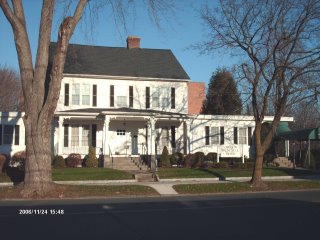
Saturday, June 02, 2007

Living Locally


I'm taking a class on Digital Libraries this semester, and I discovered this extraordinary video library today.

htp://www.ted.com/

In particular, I found this video of James Howard Kunstler, whom I mentioned in an early post as one of the influences that prompted me to start this blog. In Mr. Kunstler's view,
"public spaces should be inspired centers of civic life and the physical manifestation of the common good. Instead, he argues, what we have in America is a nation of places not worth caring about. Reengineering our cities will involve more radical change than we are prepared for, Kunstler believes, but our hand will be forced by earth crises stemming from our national lifestyle. 'Life in the mid-21st century," Kunstler says, "is going to be about living locally.'"


I urge you to watch all 20 minutes of the talk. Some of the photos he shows will remind you of similar places in and around Danbury, so while you're watching, think about the best and the worst civic features of Danbury, and what we can do to enhance the best and redesign the worst.

Thursday, May 03, 2007

Cars, Destroyers of Civilization?

Quote of the Day, courtesy of Wordsmith.org.


"The automobile has not merely taken over the street, it has dissolved the living tissue of the city. Its appetite for space is absolutely insatiable; moving and parked, it devours urban land, leaving the buildings as mere islands of habitable space in a sea of dangerous and ugly traffic."

-James Marston Fitch, historic preservationist (1909-2000)


How do you feel about your car? Are you enjoying your daily commute? If you have to use one of Connecticut's interstates, you're not. I'm usually driving against the traffic, and what I see is appalling. How much longer can this go on?

Take a look at the traffic cams on I-84 sometime. Not now, but some weekday morning when you're home between, say, 6 and 8 a.m. Or on a Friday afternoon, starting around 3 p.m. Look at all those cars, most of them carrying only one person, and try to calculate how much gasoline is being wasted while they crawl along an interstate highway at 10 or 20 mph. Then calculate how many buses or trains it would take to get half those cars off the road. How does the cost of the purchase and maintenance of a few buses compare to how much has been spent on construction projects on I-84 in the past 30 or 40 years? How does it compare to government subsidies for car companies, oil companies, and highway construction companies that have been expended to encourage private automobile travel and discourage public transportation? What was life in Danbury like before I-84? How was it worse, and how was it better?

That's my research project for this summer.

Monday, April 16, 2007

Flood of 2007


This is the intersection of Newtown Road (Rt. 6) and Eagle Road this morning around 8:30. Yes, that is a car in the intersection. There are a few more just like it in the Holiday Inn parking lot just to the left of this picture.

Saturday, April 14, 2007

143 Main Street


This is a perfect example of what I was talking about yesterday. Who wouldn't want to live over a variety store on Main Street? You could step out your door in the morning, stop and get a cup of coffee and a newspaper, walk to work or to the train station or catch a bus, walk to the Palace Theater (if it were open), walk to a number of good to excellent restaurants, walk to the grocery store and the laundromat and the library...well, you get my drift.

Sure, I recognize that not everyone is a natural-born city dweller. A lot of you left The City and Long Island to get away from exactly this kind of lifestyle. But rest assured that there are plenty of people who would be very happy indeed to live in a reasonably priced apartment in downtown Danbury. After all, what is the vacancy rate of apartments right now? I haven't found any figures, but I'll bet it's not very high. I'll bet it's not as high as the vacancy rate for commercial and office properties.

There is no good reason for the fourth floor of this building to be vacant. (And I'm not too sure about the third floor, either.) What does our city need to do in order to make it feasible for the owner of this building to open up the upper floors to housing?

173 Main Street


Who wouldn't want to live over Nico's Pizza? And the owner of this building clearly cares about it. Look at the carefully preserved detail over the windows. And yet...the upper floor appears to be vacant. Why? What needs to change before the owner of this building decides to make the third floor available to renters?

Friday, April 13, 2007

264 Main Street


This building and its neighbors are notable for their arched windows and attractive cornices. The building on the left looks bare by comparison. But the feature that really sets them apart from a lot of other Main Street buildings is that the upper floors appear to be occupied. Far too many buildings have empty second and third floors, and a few are even boarded up. Not very attractively, either. I don't know why they're empty, so I don't know what we'd have to do to make it financially attractive for the owners of those buildings to make the upper floors habitable again. Is there a minimum number of parking spaces that each dwelling unit must have? Who needs more than one car--if that many--when you live on a bus line and just blocks away from the train station? Are there accessibility requirements imposed when remodeling older structures? Can't we make an exception for 100-year-old buildings? Or must we wait until they deteriorate to the point at which we have to tear them down and start over, like the Danbury Gas and Electric building is on the verge of doing?

The traditional Main Street model has always been shops, restaurants, and other retail services at street level, and residential on the upper levels. We could go a long way toward solving our affordable housing problems if we just made full use of our existing infrastructure again.

Smart Growth

I attended this forum on Wednesday night. I am reprinting Robert Miller's excellent report here because News-Times articles generally go to archive within days, and then they are very difficult to find again. It's about time that the City of Danbury, the towns of Fairfield County, and the entire state of Connecticut, asked its citizens what kind of development they want to see here in the next 5, 10, or 20 years. Continuing to build more highways and turn more farmland into 2- and 3-acre zoned subdivisions is clearly a losing proposition in my view.


Apr 13 2007 4:15 AM
Smart Growth advocates key in on regional cooperation
By Robert Miller
THE NEWS-TIMES

The mixed-use redevelopment of the old Gilbert & Bennett factory in the Georgetown section of Redding is seen as one example of Smart Growth principles in effect.
It seems counter-intuitive, but it may take regional cooperation to preserve good neighborhoods within a town.

On Wednesday, panelists at a forum on Smart Growth discussed the need for the state to take a different approach to development -- one that preserves open space, slows the spread of suburban sprawl and rebuilds the state's inner cities.

"It's not a question of whether we grow, but how we'll grow," Heidi Green of 1000 Friends -- a pro-Smart Growth organization, who spoke at the forum sponsored by the Universalist Unitarian Congregation of Danbury.

Green -- along with urban planner David Kooris and Steven Patton, director of the Nature Conservancy's Devil's Den preserve in Redding and Weston -- spoke of how people in the state are increasingly starting to recognize that some problems are not well-served when there are 169 independent towns to deal with.

Green said under the current political structure, towns must compete against neighboring towns for development to build up their tax revenues, largely to pay for the ever-increasing cost of running a public school system.

"They need to get as much tax revenues out of development as possible," she said.

The end result is housing and development patterns that constantly push out from urban centers, eroding the state's existing open space.

It means people spend more time commuting than ever, more time on the road, and more money on gasoline. That means heavier commuter traffic and more air pollution.

Kooris is a senior planner with the Regional Plan Association, which helps towns and the three states of the greater New York City metropolitan region. The entire region is facing the same challenges as Connecticut.

"They can't be faced alone," Kooris said.

Patton of the Nature Conservancy pointed out that preserving natural resources is also always a regional effort, simply because rivers, mountain ridge lines, forests and wetlands couldn't care less about town boundary lines.

Nor can any town afford to buy a lot of land because of the cost of real estate in Fairfield County.

"But that's a good thing," Patton said. "It forces us to talk together, think together, plan together."

In recent months, the Smart Growth message -- that regions should concentrate growth in places where there are existing stores and office and train stations -- is catching on.

Gov. M. Jodi Rell has created the Office of Responsible Growth to help further Smart Growth goals in the state. And Green said there are several good examples in the state -- including the mixed-use redevelopment of the old Gilbert & Bennett factory in Georgetown, the Blue Back Square development in West Hartford, and the creation of a town green in Mansfield -- where Smart Growth principles are in effect.

Even a small town like Higganum has used community discussions to decide what the town center should look like, then changed roads and added sidewalks to promote that look.

"This isn't just a big city thing," she said.

Danbury City Planner Dennis Elpern, who attended the forum and took part in the fully engaged discussion afterward, pointed out that the proposed Kennedy Place development in Danbury -- to build 500 housing units on the former Amphenol site off Kennedy Avenue -- is another example of building housing in an urban center, near both the city bus lines and the Danbury rail station.

Green pointed out that such approaches can either create new neighborhoods or revive old ones. But she warned that at its worst, it can create gentrified neighborhoods that jack up rents and drive low-income people away.

"That's one of our greatest challenges," she said.

Kooris said Smart Growth works when architecture actually organizes the way people live and travel, and when people in a community are fully involved in planning the town's future.

"Some people are good at reading the numbers on a project," he said. "Some people like maps. Some people like models. You should always seek more input from people, not less."

Kooris said new developments will also succeed when the town and developers agree on what the town and a region can support.

"You need a flexible framework," he said.

Green said there are also looming pressures to build up even more of the region. The population of the United States now stands at about 300 million. It should top 400 million in less than 50 years.

"Connecticut is located between Boston and New York," she said. "A lot of people are going to want to move here."

But currently, Kooris said, the state is hemorrhaging young adults who cannot afford the price of housing in Connecticut.

And Elpern and others at the forum pointed out that in the Danbury area the wealthier suburban towns have often walked away from their responsibilities when it comes to building affordable housing.

"Americans are (conflicted) when it comes to Smart Growth," Elpern said. "They don't like suburban sprawl. But they don't like high-density housing either."

# Contact Robert Miller

at bmiller@newstimes.com

or (203) 731-3345.


There will be a Forum on Responsible Growth on April 19 from 7 to 9 p.m. at New Milford Town Hall.

Connecticut Community Foundation and 1,000 Friends of Connecticut will sponsor the event in cooperation with the Litchfield Hills Greenprint, Housatonic Valley Association, Connecticut Conference of Municipalities, Northwest Conservation District, Working Lands Alliance and the Trust for Public Land.

The public is encouraged to attend.

Related Stories

* Forum focuses on Smart Growth Thu, Apr 12 2007


Thursday, April 12, 2007

Remembering Kurt Vonnegut


When the last living thing
has died on account of us,
how poetical it would be
if Earth could say,
in a voice floating up
perhaps
from the floor
of the Grand Canyon,
“It is done.”
People did not like it here.

"Requiem," by Kurt Vonnegut

Thought for the Day

"A city that outdistances man's walking powers is a trap for man." -Arnold Toynbee, historian (1889-1975)

(thanks to Wordsmith.org for today's quote)

Sunday, March 25, 2007

78 Deer Hill Avenue


There are many grand old homes on Deer Hill, but I'm a sucker for Victorians, though I could never afford the upkeep. This one is my favorite. I can imagine a time when people would sit out on this porch on a summer evening and wave to their neighbors as they promenade up and down the street.

Nowadays most homes don't have porches, and most streets don't have sidewalks. I can't help but think that we lost something priceless when we moved from a neighborhood-centered culture to a car culture.

Wednesday, March 21, 2007

Good News for Commuters

Maybe I really will be able to ride the bus to work one of these days.

Here's a link to the story, but they usually go to archives in just a few days.


Mar 21 2007 4:12 AM
State urged to put buses on the roads
By Robert Miller
THE NEWS-TIMES

[photo: Linda Tarjanyi, of Danbury gets off the bus at the Kennedy Avenue bus stop in Danbury on Tuesday.]

Too many people are driving on the state's roads.

"I-95 is a traffic nightmare," Karen Burnaska, coordinator of Transit for Connecticut, said Tuesday. "I-84 is becoming almost as congested."

In a report issued Monday, Transit for Connecticut asked the state to take some of those cars off the road by increasing state spending on bus transportation by nearly $280 million over the next five years.

The report said this would help the state's economy, its residents and the environment by creating a more mobile workforce without adding cars to the highways.

"The point is we need to give real choice to the residents of Connecticut," said Gloria Mills, executive director of the Connecticut Association for Community Transportation, one of the members of Transit for Connecticut coalition. "We need options that are flexible and affordable."

Transit for Connecticut's members include business groups and transportation and environmental advocacy groups, including the Connecticut Fund for the Environment.

The report comes at a time when Gov. M. Jodi Rell and other state leaders are trying to change the state Department of Transportation's decades-long devotion to highway spending by adding more mass transportation to the mix.

Michael Sanders, DOT transit administrator, said Tuesday the DOT has let the state's bus system languish.

"I've been here 13 years, and we haven't increased spending on bus transportation that would have allowed it to grow," Sanders said.

At the same time, Sanders said, it's become increasingly clear all the state's major issues -- economic growth, environmental protection, smart growth, combatting sprawl, and access to health care -- come back to improving its transportation system.

The report says Connecticut spends less on transportation than Northeast states of comparable size, including Rhode Island, New Jersey and Maryland.

"There's no way rail and bus transit will ever take the place of the highways," Sanders said. "But there are some things rail does best and some things buses do best."

The state is finding new ways to mix and match these different modes of traveling, he said. For example, Sanders said, the state runs a daily express commuter bus from Stamford to White Plains, N.Y.

"We have people taking the train from Branford to Stamford, then getting on the bus," he said.

The state has big sections -- especially the northwest and northeast corners -- where a rail infrastructure doesn't exist.

"But there are still people there that need to get to jobs, that need to get to doctors' appointments," Sanders said.

In Danbury, the HART/Housatonic Area Regional Transit bus system is studying commuter bus service to Waterbury and Bridgeport, said Richard Schneider, HART's director of service development.

HART also plans to offer shuttle service from New Fairfield to the Metro-North railroad station in Southeast, N.Y.

Schneider said HART's two existing transit shuttles -- which take Danbury commuters to the Metro-North station in Brewster, N.Y., and Ridgefield commuters to the Metro-North station in Katonah, N.Y. -- have been solid successes.

"The Ridgefield ridership has increased by 25 percent in the past year," Schneider said.

The Transit for Connecticut report calls for expanding bus routes by offering more runs during crowded hours and providing more weekend service. It calls for creating rapid-transit bus service along major transportation corridors, expanding the Dial-a-Ride service to towns not served by buses, creating more commuter connection services to trains, and expanding express service between major employment centers.

According to the report, the state could increase bus ridership by 81 percent. Mills, of the Connecticut Association for Community Transportation, said the figure now stands at about 35 million rides a year.

But, it will cost the state about $63.6 million over the next five years for operating costs and another $215 million for new buses.

Burnaska, coordinator of the Transit for Connecticut coalition, said the state needs to replace its buses with new, clean-diesel buses, or retrofit existing buses to make them clean diesel.

With an enlarged fleet of such buses running more routes, she said, many drivers would choose to use them for commuting, reducing the number of cars on the road and cutting pollution, she said.

It would also promote what Rell's administration calls "responsible growth" -- encouraging development in urban centers with existing infrastructure, while slowing sprawl into the suburbs.

However, coalition members said Rell's proposed 2008-09 budget calls for a 20-percent fare increase for state bus riders. Mills said fare increases generally discourage people from using mass transit.

While the state budget contains $7.5 million to purchase new buses, Mills said, it has no extra money for operating those buses.

The proposed budget also cuts a $5 million-a-year grant program that helped towns develop new bus routes or improve existing ones to serve the elderly and people with disabilities.

"We hope that money will be restored," she said.

"It is that issue -- how much money the General Assembly decides to spend on improving bus transit -- that will determine the fate of the report," said the DOT's Sanders.

# Contact Robert Miller

at bmiller@newstimes.com

or at (203) 731-3345.

Tuesday, March 13, 2007

Commuting


This is what commuting on I-84 feels like most days. And I'm not usually in the worst of it.

Monday, March 12, 2007

The Palace Theater

The Palace Theater
A story in Sunday's New York Times Connecticut section titled "A Renaissance in Full Bloom for Aging Thearers," by Elizabeth Maker, prompted today's entry.

RICK DOYLE remembers when icicles hung from the ceiling and saplings grew amid the mold and broken glass in the lobby of the abandoned Warner Theater in the early 1980s. Despite its artistic history, the 1931 landmark building appeared headed to becoming just another city parking lot.

Today, $20 million later, the Warner Theater in Torrington is a magnificent example of the height of Art Deco, rivaling even the Bushnell in Hartford.
The Palace theater
The state allocated $65 million in bonds for theater projects in the last decade, and the commission [the State Commission on Culture and Tourism] gave $555,000 in grants to 25 theaters in the last fiscal year to help with operating costs.

The Palace Theater in Danbury is in the same position that the Warner was 25 years ago, but it hasn't received any of that money. If not for the Martha Apartments, it might have already become a parking lot by now.
The Palace Theater

In Stamford, the Palace Theater, built in 1927, recently underwent a $16 million renovation, and a $2 million project is planned for the subground space, including a 199-seat theater and a new performing arts education center to be named after Pitney Bowes, one of the Palace’s benefactors.

The Palace was still a movie theater when I moved to Danbury. Over the years it was split up into three smaller screens, with only remnants of its former glory showing here and there. I wish I could show you a picture of the lobby, but it's been closed for years.

In Waterbury, the Palace Theater, which opened its doors in 1922 but had been closed for 18 years, reopened in 2004 after a $30 million makeover. “Our ticket sales went up last year to 105,000, from 90,000 the year before,” said the theater’s executive director, Frank Tavera.

It's not too late for the same kind of miracle to happen in Danbury.

In Torrington, the Warner’s executive director, James Patrick, walked along Main Street, showing off a 50,000-square-foot space, next to the theater, that is being transformed from a vacant department store into the Warner’s new Carole and Ray Neag Performing Arts Center, named for the benefactors who donated $1 million last year to the project. The center will include classrooms, a new 200-seat theater and several retail stores and restaurants surrounding a grand lobby.

The record number of ticket sales last year — 92,000, up from over 80,000 the previous year — “shows you how much people love this place,” Mr. Patrick said.

“And look what the Warner has done for this city,” he added, pointing across the street at freshly painted building facades and bustling new businesses. “Torrington has gone from a depressed old mill town to a thriving arts center that’s just teeming with life.”

Tuesday, March 06, 2007

But Then There's This

Today's News-Times reports that BRT is definitely going to market its new Crosby Street apartments to WestConn students.


Apartments marketed to WestConn students
By Elizabeth Putnam
THE NEWS-TIMES
Brookview Commons on Crosby Street in Danbury, a 115-unit apartment complex marketed to Western Connecticut State University students, is scheduled to open in August.
DANBURY -- A new Crosby Street apartment complex marketed just for college students is on track to open in August.

The developer, BRT, will rent all of its 115-unit apartment building to Western Connecticut State University students. The building, called Brookview Commons, offers furnished studios and one- and two-bedroom apartments and is on WestConn's shuttle bus route.

"We are doing well. About 15 percent of our units are reserved. It's going to be great energy for downtown," said Dan Bertram, a principal in BRT.

BRT, which officially began marketing the development to students last month but had been considering the option for several months, also likely will keep the tax incentive it received from the city in 2005 to build downtown housing.

The incentive allows BRT to pay a flat fee of about $25,000 in annual property taxes for seven years, after which the taxes will jump to about $340,000.

After BRT announced that it might rent the complex to students earlier this year, some city officials questioned whether the incentive should be rescinded.

BRT never agreed in writing or verbally to build market-rate housing for families and can rent its new complex to college students, according to a recent review by the city's corporation counsel.

"The possibility that the apartment building may ultimately have ... an occupant class that has been changed as a result of a market need is therefore insufficient to rescind ...," Deputy Corporation Counsel Les Pinter said in a report to the mayor and Common Council.

Democrats said BRT received the deferral with the understanding that the company would build "middle-income, market-rate housing for families."

"Although this legal opinion rules out rescinding the tax giveaways, the fact remains that the developer violated the spirit of the agreement with the city, which underscores the need to more closely scrutinize any such proposals in the future," Democratic caucus leader Tom Saadi said Monday in an e-mail.

The corporation counsel's report will go before the Common Council today, where it likely will be accepted by the Republican-majority council.

Saadi, however, said the city needs to do more to restrict tax incentives.

"The city should amend the ordinance and limit these types of tax deferrals and abatements to those businesses and industries that create long-term jobs in our city and increase our tax base, not weaken it," he said.

BRT received a similar tax incentive to build about 560 condominium units on Kennedy Avenue. That tax deferral will benefit the condo buyers, who will pay no property taxes for seven years.

Construction of that project is expected to start this spring.

# Contact Elizabeth Putnam

at eputnam@newstimes.com

or at (203) 731-3411.


I don't know about you, but this isn't what I had in mind when I heard that BRT was building "downtown housing." I had in mind a lot of working singles and families who wanted to be near public transportation, restaurants, shops, and grocery stores, not a building full of transitory college students.

I wonder what this signals for the fate of the "luxury condo" project scheduled for the empty parking lot that used to be the old Amphenol property?

The Best News I've Heard About Downtown Danbury in a Very Long Time

This story ran in the Monday, March 5 edition of the News-Times. You can read it here on the News-Times website, at least for a few days.

"City may create review panel: Architectural board would ensure designs comply with others, By Mark Langlois, THE NEWS-TIMES"


DANBURY -- The city is considering creating an architectural review commission to make sure new buildings are designed to look compatible with others in the city.

The city has an Architectural Advisory Committee, but the new plan would give a new commission, whatever its name might be, more power.

For most of the committee's 18 years, it has reviewed signs proposed by new businesses. The committee's goal has been to help a business design a sign that will attract customers and at the same time fit in with other signs and building facades in the neighborhood. While the committee has some influence over signs, it doesn't have as much as committees in other towns do.

Danbury Mayor Mark Boughton said he will propose a more powerful committee at Tuesday's Common Council meeting. He said he first proposed one in 2002, but the idea was rejected. People argued against it then, saying it might be too much of a financial burden on downtown developers.

In other towns, the committees can influence more than sign design.

"In other towns, like Southbury, Glastonbury and Ridgefield, the committees have more power," said Mark Nolan, chairman of CityCenter Danbury, the downtown tax district that sponsors the advisory committee. They make recommendations about the shape and facade of a building to local planning commissions or to zoning commissions before a building is approved. The golden arches of McDonald's restaurants disappear behind wooden facades.

Danbury officials are hoping the new commission, if approved, will have that kind of power.

Committee members like the look of downtown Glastonbury, Ridgefield, Southbury and Northhampton, Mass., where they say more powerful architectural committees already work.

"The main street of a town or city may be only 5 percent of a town, but that's what gives a town its identity," said Joseph Heyman, an urban planner and member of the Architectural Advisory Committee.

Heyman said visitors who reach Danbury's outlying streets see the exact same big-box retail stores and franchise food stores they see across the country. If the city had an architecutral review committee, it might be able to influence what those big-box retial stores look like.

"We're asking developers and business owners to be sensitive about how their business will look from the outside," Danbury architect Leigh Overland said. Overland is also a member of the Architectural Advisory Committee.

Boughton said the architectural review committee concept must be reviewed by an ad hoc committee of the Common Council before it can be approved.

City Planner Dennis Elpern said he proposed such a committee in the city's Plan of Conservation and Development approved in 2000, and he still supports the idea of architectural review.

"It's a question of teeth" or power, Elpern said. "An architectural review board can make recommendations."

"Other towns have been quite successful in influencing the design of facades to make improvements on how buildings look," Elpern said.

He said the level of influence such a commission has depends on the members and their skills at working with people.

Contact Mark Langlois

at mlanglois@newstimes.com

or at (203) 731-3337


But note the weasel words "may" and "could." I would never expect downtown Danbury to ever look like downtown Ridgefield or downtown Glastonbury. It's far too late for that. But maybe we can keep it from becoming another downtown Stamford or downtown Bridgeport.

Sunday, December 17, 2006

104 Main Street


St. Peter's Church has for many years been the venue for the annual performance of Handel's Messiah, presented by the Danbury Music Centre, and I am happy to say that tonight's the night! I missed it last year because I was working at the mall, but I'll be there tonight.

Quoting from today's New-Times:
"The 125 performers of the Danbury Concert Chorus and the Danbury Baroque Chamber Orchestra will be under the direction of Richard Price. Joining the ensemble are organist Stephen Roberts and harpsichordist Maxim Vladimiroff.

"Soloists are soprano Jane Thorngren, meszzo-soprano Laura Vlasak Nolen, tenor Walter MacNeil, and bass Walter Du Melle."

This is one of those events that make Danbury such a special place to live. It's always standing room only, so get there when the doors open at 6:30 to get a good seat. The performance starts at 7:30. Admission is free, but donations will be gladly accepted.

St. Peter's is an example of what a downtown church should look like. It's situated right at sidewalk level. No unsightly parking lot for them. This church is for people, not for cars.

Friday, November 24, 2006

57 Main Street


We had a heck of a rainstorm here last week, and it knocked down the few leaves that were still clinging to the trees. Since daylight savings time ended, the days have become noticeably shorter, and the sun sets behind the hills in front of my house around 4 p.m. these days. After some unseasonably warm weather, it's obvious now that there will be a winter again this year. And there's something about the dying of the light and the dying of the year that makes us reflect.

It's been a heck of a semester for me, but the end is almost in sight. I got in way over my head registering for three classes, but it took me a few weeks to realize it. By the time I dropped one class, the other two classes were already suffering, and I never really quite caught up. I've started looking for a "real" job--either a full-time job, or a part-time job that pays more--but so far I've only had a couple of disappointments. I need to learn to relax and concentrate more on school, but the end of my financial reserves is in sight, and it's a race to see which will happen first--running out of cash or finishing the degree.

As the old year winds down, I am reminded that this too shall pass. The new year always comes, and it always brings fresh promises of better days. So in that spirit, I present to you Green Funeral Home, a Main Street fixture since 1935. No Main Street would be complete without a funeral home, and this one is a classic from the days when Danbury residents would likely as not walk to the funeral home to see their friends off one last time. Yes, it does have parking, but the cars are unobtrusively parked around back--this building hasn't turned its back on Main Street.

Maybe you are not at a point in your life where this has been forcefully brought to your attention yet, but believe me when I tell you that life really is short. If there's something you've been meaning to do "one of these days," do it. If there's something you have been meaning to tell a friend or loved one but have been putting it off, say it. We have five whole weeks, and an odd number of days, until the New Year. Don't put off until then what you can start today.

Monday, October 30, 2006

220 Main Street


The Savings Bank of Danbury was established in 1849 as the first mutual bank in Danbury. It originally operated out of the Main Street home of its first treasury secretary, George White Ives. The building shown here was built in 1909, and still houses the main branch. (Danbury. Danbury Museum and Historical Society. From the series Images of America.)

I don't believe the front door is ever open these days. The main entrance is around the corner, in the newest addition. Hmmm, "White Ives"? After 30+ years of living here, I'm beginning to understand why we see these two names so often.

Saturday, October 21, 2006

238 Main Street


"The Danbury Gas-Light Company was incorporated in 1854 and went into operation in 1857 at the Danbury and Norwalk Railroad Depot. In 1913, the Danbury and Bethel Gas and Electric Company purchased this building and electrified its exterior. Built in 1891 by Danbury designer Joel Foster, the terra-cotta Victorian was sold to the Zuccas in 1965."

from Danbury. (2001) Danbury Museum & Historical Society. Arcadia Publishing. (p53)

If and when the city achieves Certified Local Government status and acquires some of those National Park Service dollars, this building would be my candidate for the first restoration project. Actually, I'd like to see this happen even sooner. Twenty or thirty years ago would have been a good time. I confess that I know nothing about construction costs for a project like this, and nothing about the state and local building codes that would have to be satisfied. Nor do I know who owns the building today. But it's still a beautiful building and worth saving, in my opinion.


Here's a closer look at the art deco script in the window.

Sunday, October 15, 2006

90 White Street


Page B1 of today's Danbury News-Times has a story on a city project to achieve Certified Local Government status under a National Park Service program.

"That status will allow the state Commission of Culture and Tourism to add the library [the Old Library at 256 Main Street, that is] to its state list of historic buildings. It will allow the city to set up its own Historical Commission. And it will make the city eligible for U.S. Park Service funding..."


The Old Library was one of the first entries I made in this blog. What I did not show were the murals that were painted by Bethel artist Charles Federer in the 1930s. (Possibly as a WPA project?) Unfortunately the murals are not pictured in the on-line edition of the story, so if you do not already have a copy of today's paper, I bid you visit the library tomorrow and see the photos. Better yet, visit the Danbury Music Centre offices some day and see them first-hand.


One of the buildings mentioned by Mayor Boughton as being historically important and worthy of preservation is the Meeker Hardware Building, pictured above. White Street is named for the same White family that donated the land and money to build the library at 256 Main Street. And, just because I like it so much, here is another photo of the Old Library.